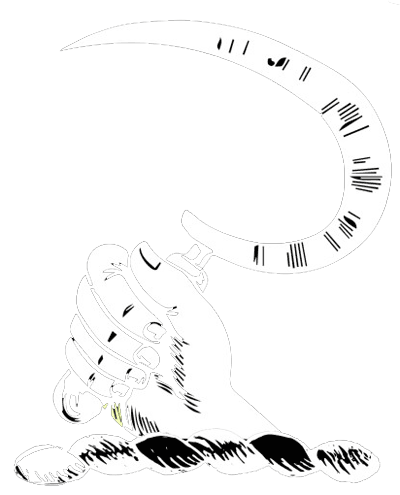
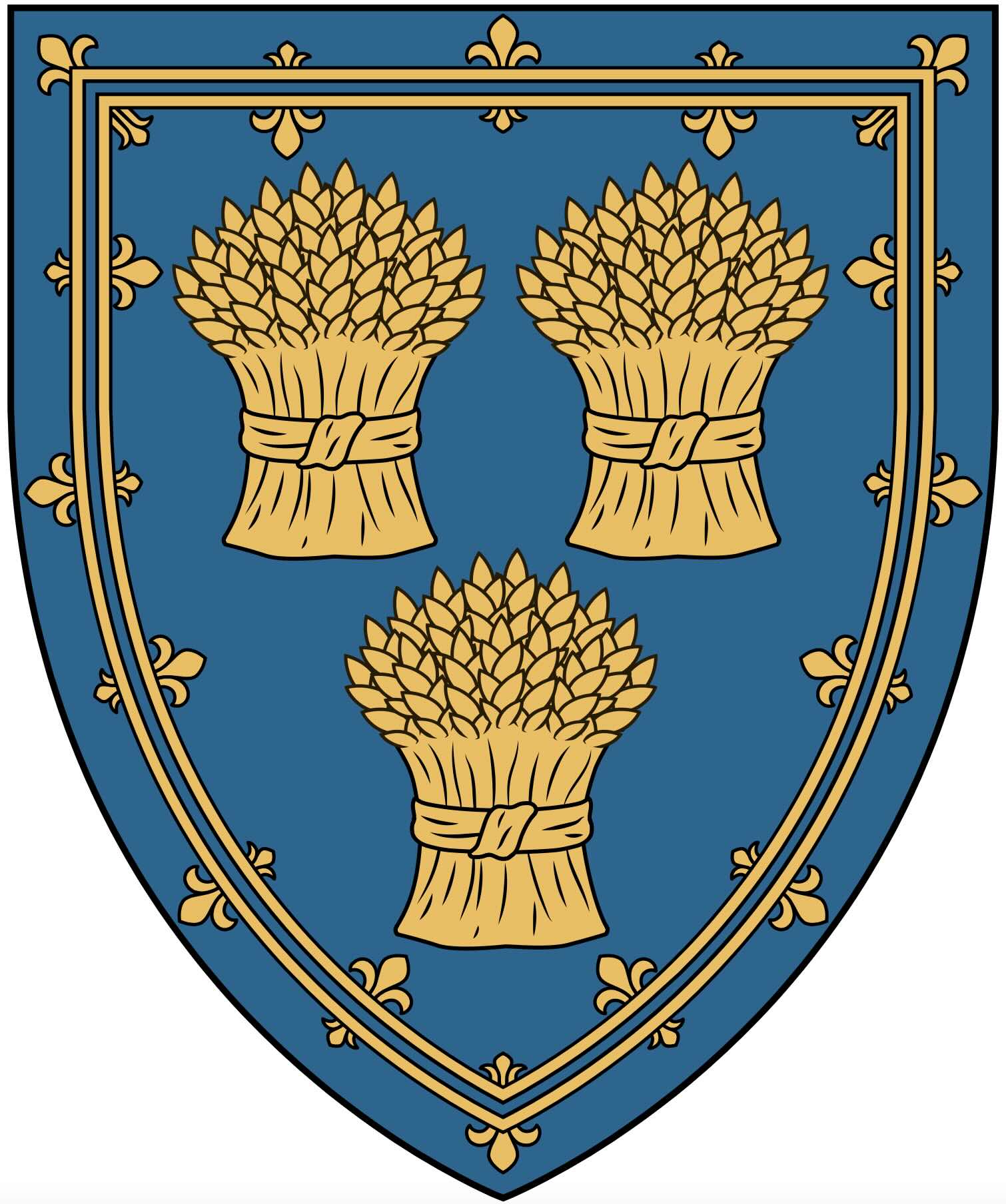
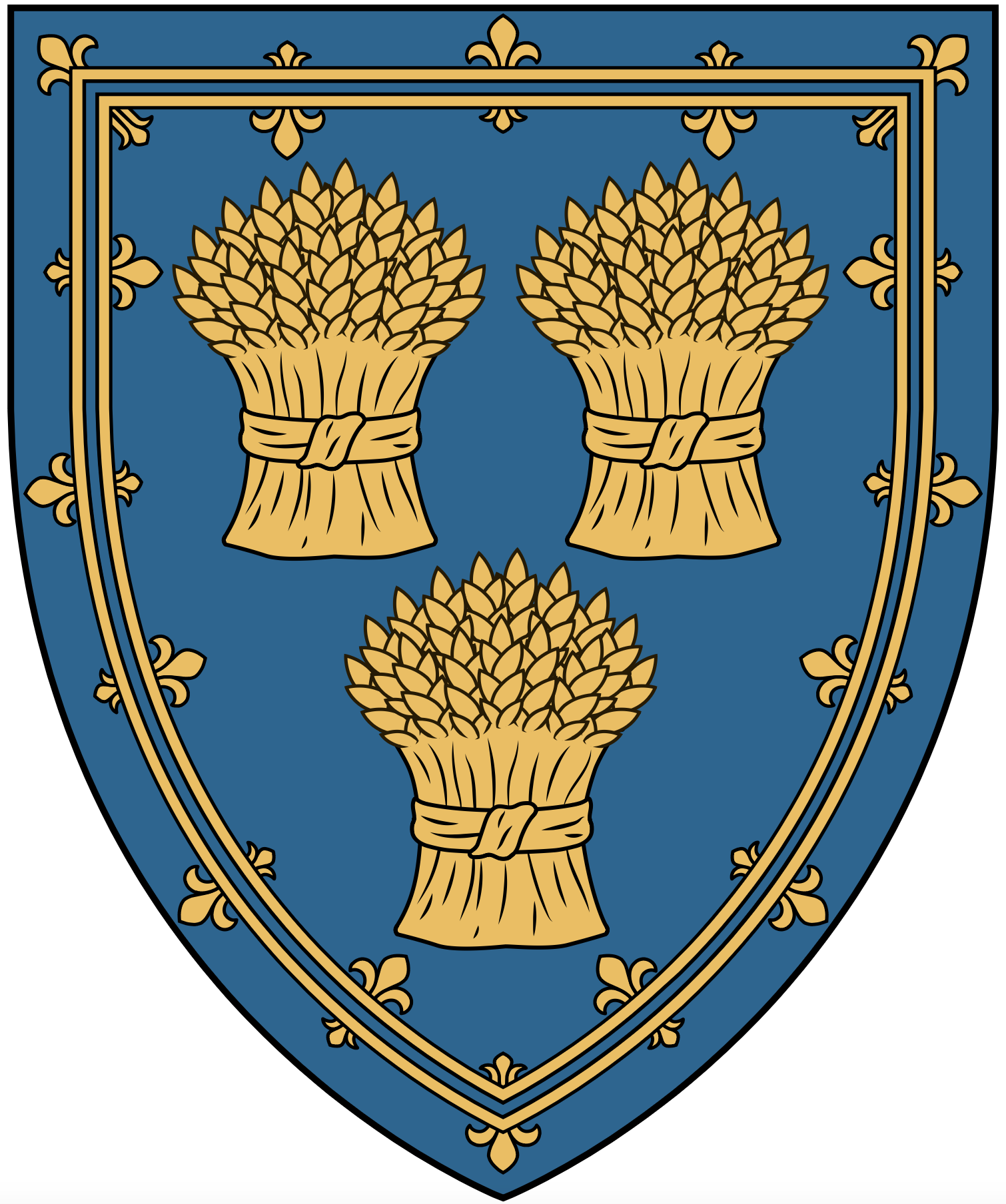
Azure, three garbs or
The Cuming shield is described as Azure, three garbs Or, two and one. [1] This means "Blue, three Wheat/Oat sheaves Gold, two above and one below".
A two and one arrangement is the default arrangement for three charges. Charges are the symbols on the shield, and in our case they are garbs (wheat sheaves or oat sheaves). Another house or clan may have lions, fleurs de lis, horses, or something else. Azure, three garbs Or is the simplest way to describe our shield. [2]
It is not our only shield, we have variations of our shield. Some to distinguish cadet branches or bloodlines, and a couple to acknowledge honours. As a general rule of thumb they all contain garbs, usually three, sometimes bordured (bordered), and sometimes royal tressured, like in the premier blue shield, and the premier red shield.
A tressure is something of a thin inner border within the shield, the word translates to a braid. The Royal Tressure is traditionally a sign of the Scottish royal families, and from around the middle of the 1500s it has also been granted on occasion as a mark of honour. [3] [4]
Our chief shield could be described as: Azure, three garbs Or, two and one, within a double tressure flory-counter-flory (the royal tressure of fleurs-de-lis). [5]
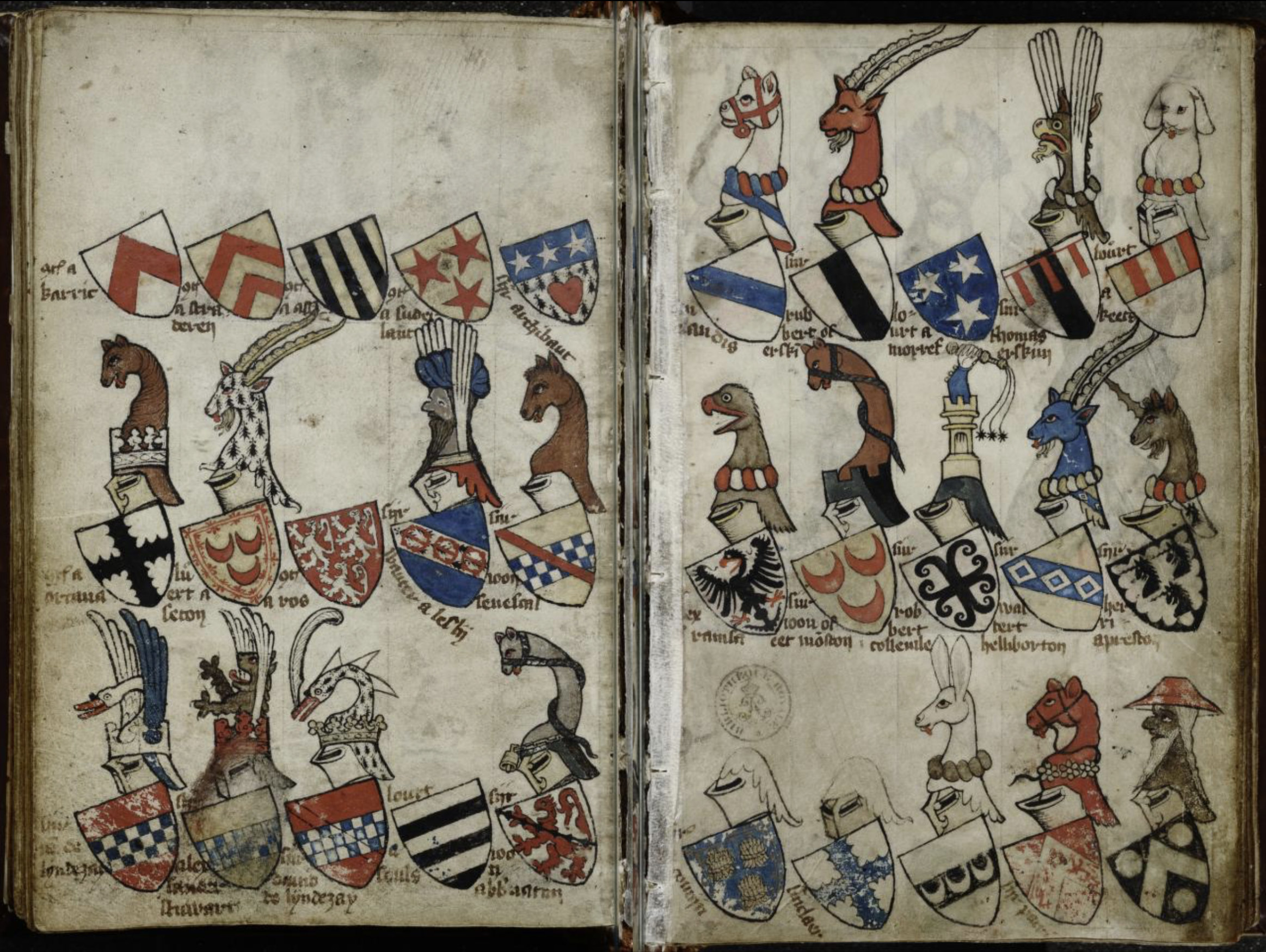
It can be found recorded in the Gelre Armourial (c.1395) on page 135 of 260. Links to two copies of the Gelre Armourial are listed below, as well as previews of pages in mention: Royal Library of Belgium digital edition, Internet Archive digital edition. The Gelre Armourial is a famous 14th-century manuscript of European heraldry, containing ~1,700 coats of arms.
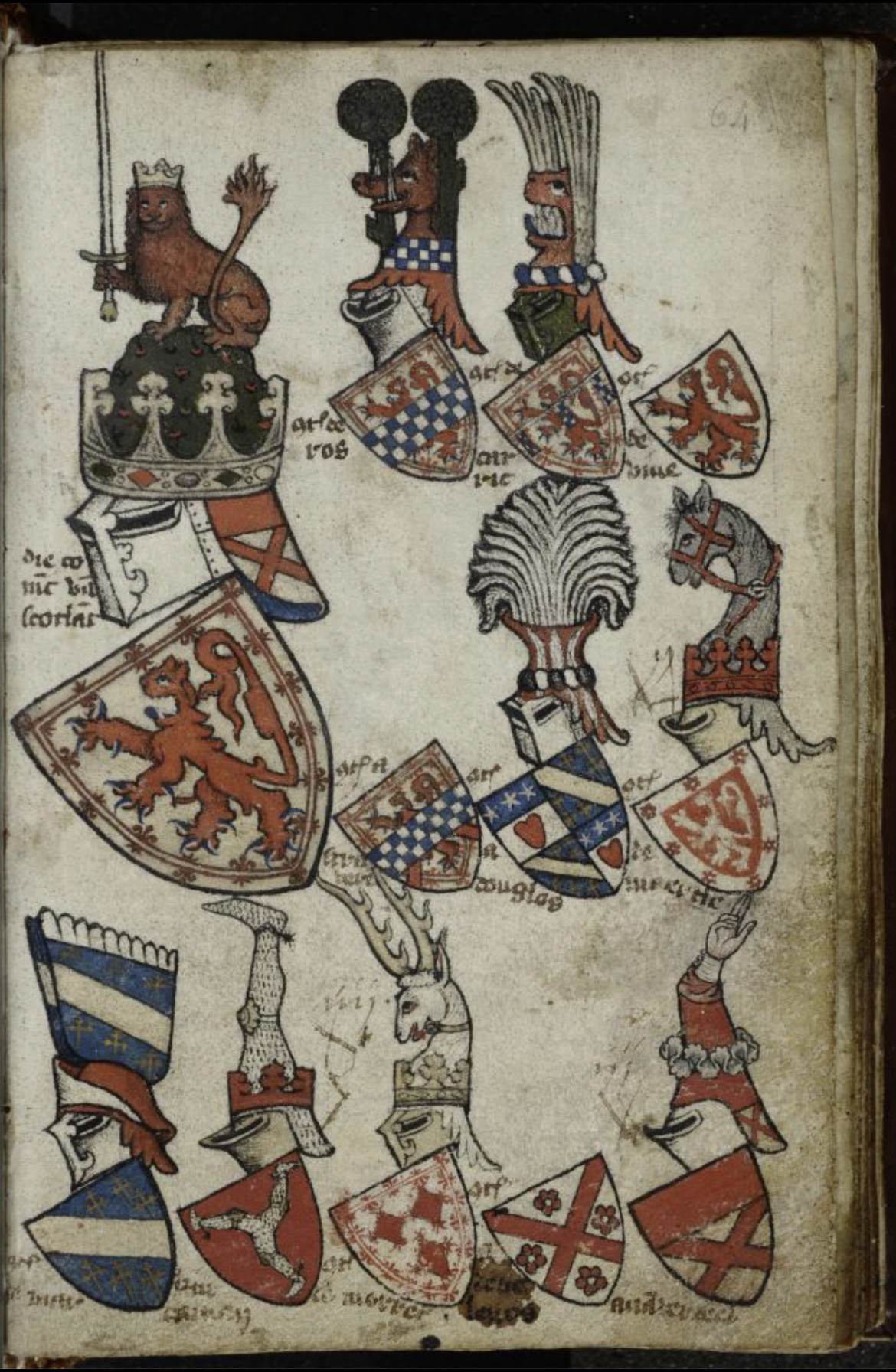
The Comyn shield in the bottom left-hand corner of page 135 is from the time when the clan seat moved to Altyre. Given the Comyn clan crest is a lion rampant, gold, holding a sword or dagger, it is likely the clan would normally have worn this on the helm. Why the clan is not depicted wearing it in the Gelre is not currently known.
A modern image of the shield depicted above, is here below.
We were a Scottish clan for some 800 years before we were an Australian clan; from approximately 1050 to 1850. The Scottish clan from which we descend are still well and in Scotland.
Before we were Scottish however, we were likely a Flemish/French house from the border land of Picardy to Flanders; approximately the region of Pas-de-Calais. This region was previously multiple regions, notably Thérouanne and Ternois (Saint-Pol). During the Roman (Gallic) period, Thérouanne was known as Tervanna and it was the primary city of Civitas Morinorum. [6] [7]
Thérouanne's name has been said to mean 'the land of oats' (Terra avanae). This meaning is supported somewhat by old Picard and Celtic, as well as Roman naming conventions. Romans often latinised an existing name and did so with Tervanna, the pre-latinised name is Celtic. It is also thought the ancient arms of Thérouanne were Azure one garb Or (in French: D’azur, à la gerbe d’avoine d’or, liée du même). [8]
Ter- / Terv- (also Tre- / Trebh-) in Celtic refers to a settlement, fortress or dwelling; the second half -vannae / -annae is often taken to mean wetlands or streams but can also mean oats and grain fields. [9]
Unfortunately for history, Thérouanne is one of the premier examples of an attempt at deliberately eradicating a city from history; and is often cited on the topic.
It was once a large and powerful city, the seat of a powerful bishopric. It was fortified and prospered in the middle ages; it had the largest cathedral in France in 1300s.
During the 1500s' Italian wars between King Francis I of France and Holy Roman Emperor Charles V, a concerted effort was made to remove this strategic stronghold for France. [10]
The city destroyed by 'scorched earth' and the ruins were dismantled. The city was carted away to build elsewhere and the site was rendered uninhabitable to prevent attempts at rebuilding. It had been an important stronghold for a thousand years or more at the time of its destruction. It had passed from the Morini to the Romans; to the Christians, the Merovingians, the Carolingiens, and finally to the Kingdom of France. [11]
It is not unlikely that significant knowledge was lost in the destruction of Thérouanne, information on Saint-Pol-Sur-Ternoise, along with information on the importance of Azure [x] garbs Or to the region. This may extend to the origins of Clan Comyn.
The Bishopric of Thérouanne was a religious centre and also a repository of administrative records, genealogies, land deeds, records of feudal allegiances, local heraldic traditions, et cetera. [12] [13]
There is a lot we do not know about the Flemish/French house that Clan Comyn descends from, but what we can infer through armourial bearings and what we have held to be true historically is that we were likely a branch of the house that ruled as the Counts of Saint-Pol (Comtes de Saint-Pol). [14]
Family Houses / Clans in this era (AD 1000) did not necessarily share a surname or a house name. It was common for the noble house to be referred to by the place (or land) they lived and controlled. We do not know for certain if the Counts of Saint-Pol were surnamed Comyn or not; it is not impossible, but it is not the only possibility. [15] [16]
As French Nobles were often named after lands they controlled or were associated with, they often used a territorial designation rather than a common family name. For example, a noble might be called 'Robert of Comines' or 'Hugues de Saint-Pol' indicating control of (or association with) Comines or Saint-Pol rather than as a shared family name.
This territorial surname would change depending on what land or fief was controlled. So, descendants could bear different names and those names would reflect the lands they inherited or ruled. [17]
During this period, French Nobles were identified by their title, such as Count, Duke, or Baron, followed by the name of their primary domain. This title was often more important than a family name because it presented both status and authority simultaneously.
The title could change (and often did) through marriages, inheritance, or new lands acquired; individuals within the same house could have different titles and names. [18]
While the Romans who had ruled over France had surnames as a part of their ('tria nomina') three part naming system, it largely fell out of use on the fall of the Western Roman Empire. [19]
The Romans had:
- a Praenomen (personal / first name);
- a Nomen (family or clan name, such as "Julius" in Gaius Julius Caesar);
- and a Cognomen (a nickname which could become hereditary).
To the Romans, the Nomen (family name) or 'gens' was very important. It worked like a clan name, the Cognomen often worked like that of a clan branch name. [20]
Very few Roman descent families are known to have survived in France (like the Syagrii or Avitus families). [21]
The use of fixed surnames did not start to become prevalent again until the 12th and 13th Centuries. [22]
Around AD 1000 in North Western France, names were highly flexible and a noble might be also be identified by personal characteristics or patronymics (named after the father, like 'Johnson' = 'John's son').
While many noble houses might be made up of related individuals, they were commonly not bound by a shared surname, but rather by a shared interest, a fealty, or by alliances. [23]
A banner could represent a larger confederation of vassals, knights, and lesser nobles who owed allegiance to a higher lord, with each group having its own identity or designation.
These alliances under one "banner" would often consist of families with different surnames all pledging loyalty to a greater noble or house. They were often related by blood, but they did not need to be. Alliances could be complex and not only due to familial relationships. [24]
Take Robert de Comines for example, said to be our earliest know ancestor: Due to his listing as an ally of William the Conqueror during the Norman Invasion, his allegiance fighting for Baldwin V of Flanders, and his shield being the same as the rulers of Beauval, we take him to be of allegiance to the Counts of Saint-Pol (also later known as House Candavène), a kin (or gens) to the Lords of Beauval (aka House Candavène-Beauval) and a vassal/subject/ally of the Counts of Flanders (due to the politics of the time in that region). [25] [26] [27]
We know he would need to be noble with important family ties for a marriage to a sister of William the Conqueror. We also know he would need to be trusted and seen as a capable leader to be appointed Earl of Northumbria (Comte de Northumbrie). [28]
We also know the region he was from (the Picardy-Flanders border) was a strong military region at the time. Saint-Pol, Beauval and Comines were all along the borderland. Saint-Pol and Beauval on the French (Picardy) side and Comines on the Flemish (Flanders) side. And we know the Flemish and Picard nobles were enlisted in the Norman conquest. [29] [30]
While technically all were under the French crown, the situation was complicated. [31]
Flanders was a powerful and semi-independent county. The Count of Flanders was a vassal of the King of France, but Flanders had significant autonomy due to its wealth, military strength, and strategic importance as a trading hub.
At times, the Counts of Flanders were in conflict with the French crown, usually over territorial disputes and sovereignty. Their strength was so great that at the formation of the Kingdom of France, the count of Flanders was seen as the king's peer, approximately his equal. [32] [33]
Pas-de-Calais is a region of France that approximately corresponds to its predecessor Artois, merged with the smaller seaside county of Boulogne. Artois in turn has changed size over the years and had originally been east of the county of Saint-Pol (Saint-Pol-sur-Ternoise) before the latter became a part of it. [34]
Earlier still, the county of Saint-Pol had been the (larger) 'Pagus Ternois' (Pagus Teruanensis). Where, the Frankish royal family the 'Unruochings' (French: 'Unrochides' (aka Hunrochides)) -descendants of Hunroch, Count of Ternois- hail. And even earlier again, in Roman times it had been the area of the Capital of the country of the Morins (Morinie), a people living in the region that Caesar called "Belgium", one of the three parts of Gaul, with the Celtic and Aquitaine. Ie. Gallia Belgica. [35] [36]
Thérouanne (Tervana in Latin) was the capital of Morini (French: Morinie).
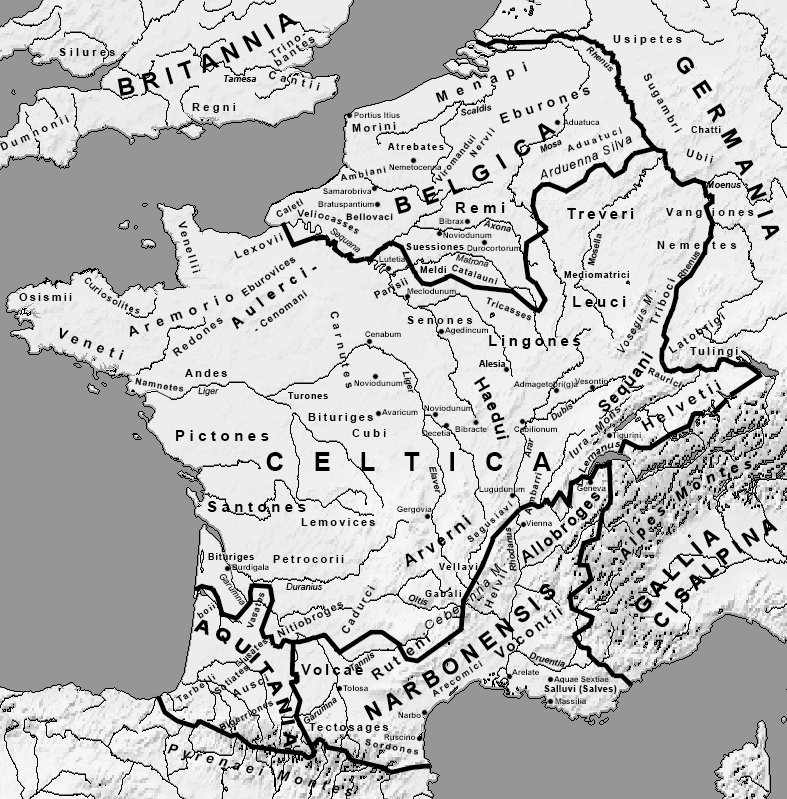
A map of celtic peoples of Gallia Belgica, 1st Century BCE.
By the period of the Norman Conquest of England the region from the Strait of Dover to the Bay of the Somme, and inland towards Laon, was home to a number of important counties between Flanders and Picardy. Saint-Pol was one of these counties, but was also a vassal of Flanders. [37]
Saint-Pol (Saint-Pol-sur-Ternoise) had previously been a stronghold for the Counts of Flanders. It was originally a fortress comprised of two very high castles, separated by a wide deep ditch.
We can read into this that Saint-Pol was one of the counties that were caught in frequent clashes between France and Flanders. [38] [39]
Because of its position, its qualities, Saint-Pol was important for military and economic reasons. It sat on the Ternoise river. The rulers of Saint-Pol had become seasoned builders of fortifications, and seasoned border defenders by c.1000 AD.
From c.511 AD to the treaty of Verdun in 843, their region had been part of Austrasia, on the borderland of the kingdom of Austrasia and (their south-western neighbours) the kingdom of Neustria. [40] [41]
Going back even further, the region had been important to the Roman Empire. Boulogne-sur-mer (its current name) was the main Roman port for trade and communications with its province of Britain. It was known as Boulogne from the 11th century to the 18th century; Bononia from the 4th century to the 11th century; and Gesoriacum was its Roman name from the 1st century BCE to the 4th century CE. [42]
It is worth noting here that much has changed between 1000 AD France and 2000 AD France. In 1000 AD, France had only recently come to be one kingdom again. As recently as 987 AD, what we know as France was divided into the Kingdom of West Francia, the Duchy of Lotharingia (known as the Kingdom of Middle Francia for a short time), and the Kingdom of East Francia. The royal power had not been where it is now in Île-de-France (Paris), as that was the homeland of the new King Hugues Capet and was yet to become so. [43]
For a compressed simplification in contemporary national borders, West Francia approximates to modern day France, minus the French region of Brittany and some of the modern Eastern regions; Middle Francia was similar to approximately modern day Belgium, Netherlands, Luxembourg, parts of Western Germany, parts of Switzerland, and Northern and Central Italy; and East Francia was similar to approximately modern Germany East of the Rhine, and Austria combined.
The capital of West Francia was Laon, near the furthest upstream reaches of the river Somme and near the banks of the river Oise. Laon is about 130km South East of Saint-Pol, or about 4.5 days walk in medieval times; 2 days ride as a noble with fresh horses at posting stations. Laon is about 120km North East of Paris, and Paris is about 170km due South of Saint-Pol. Saint-Pol sits on a tributary to an important river of the time, the Canche. [44]
Approximately 40km East of Saint-Pol is Montrieul (Montrieul-sur-Mer). The two are connected by river Canche and tributary Ternoise.
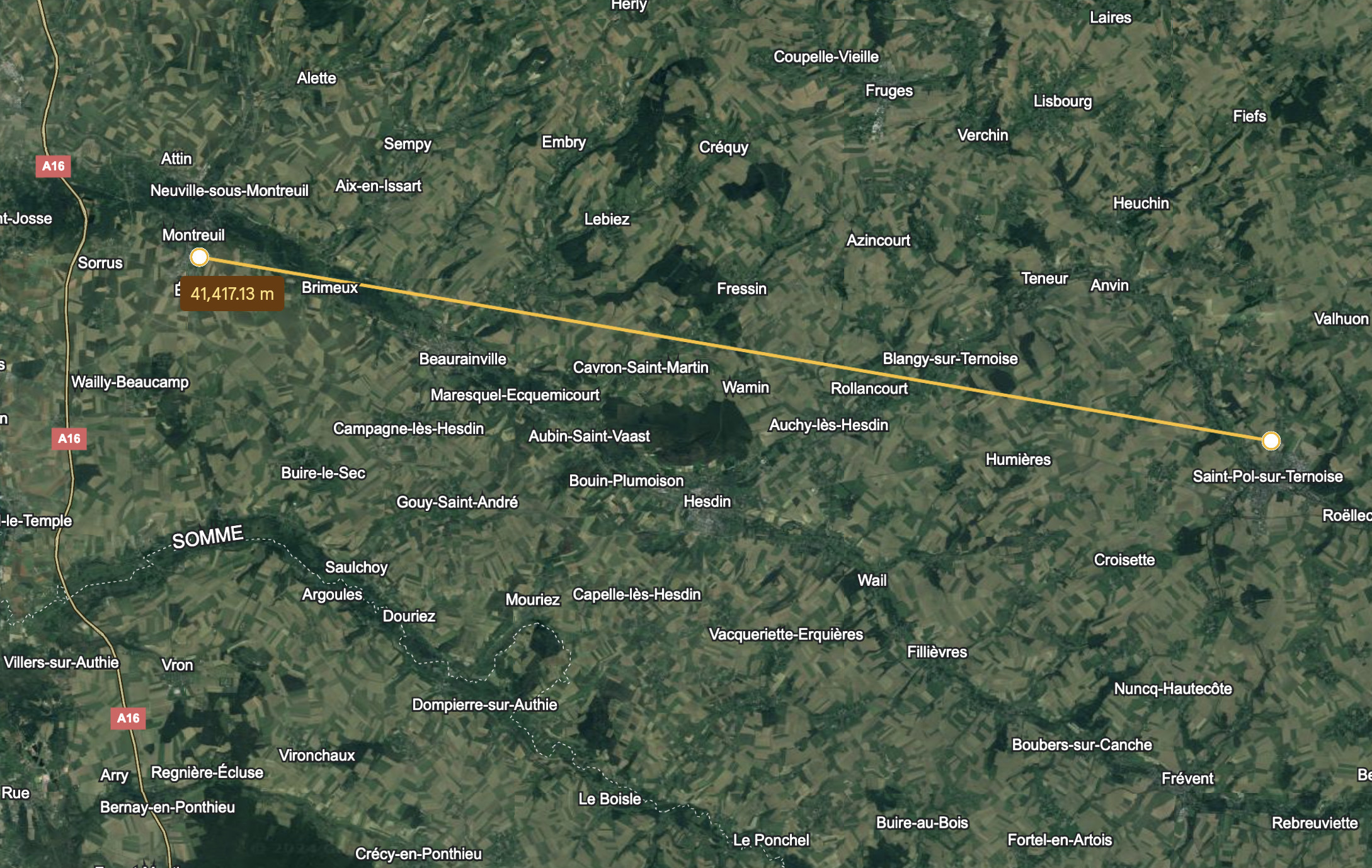
This region was a strategic Royal port of West Francia and of great interest to the new King, Hugh Capet. The origins of Montreuil lay in Roman times as a sea port. Montreuil-sur-Mer translates to Montreuil on the sea. [45]
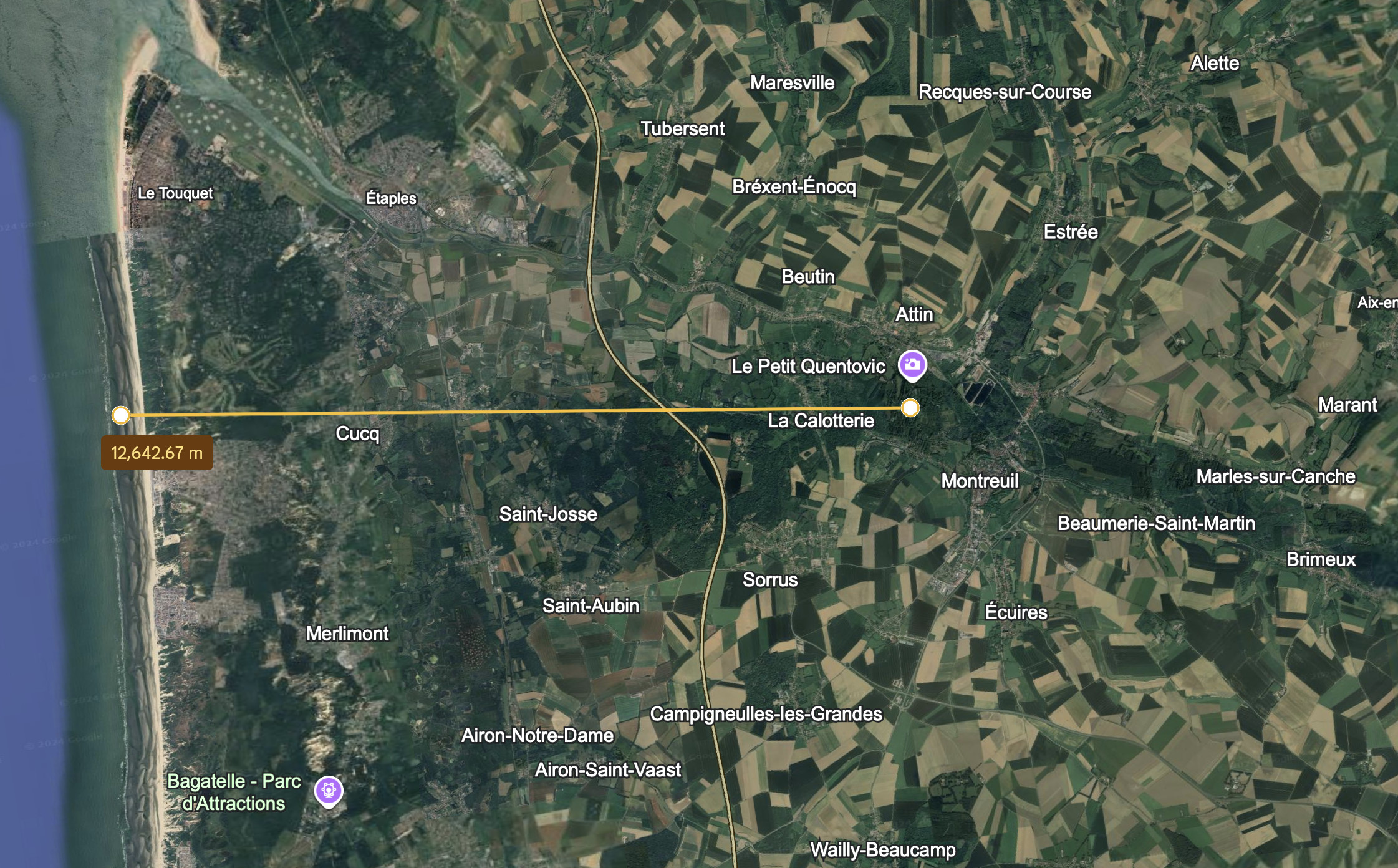
Today it is some 12km from the sea. However, by the 11th Century it was the main sea port of the Capétiens (The rulers of France from Hugh Capet in 987 to his descendants in 1792). [46]
This area of the mouth of the Canche was also home to the principal early medieval port in northern France (and perhaps most important of Frankish seaports and port markets), Quentovic.
From the turn of the 5th to 6th Century (c.480s to 520s), Quentovic -aka Quentovicus- was the the place where Anglo-Saxon monks would cross the English Channel on their pilgrimage to Rome. It minted coins for the Merovingians and then Carolingians. It has been said that Charlemagne would have had a difficult time funding his army without the tax income gained from Quentovic. [47] [48]
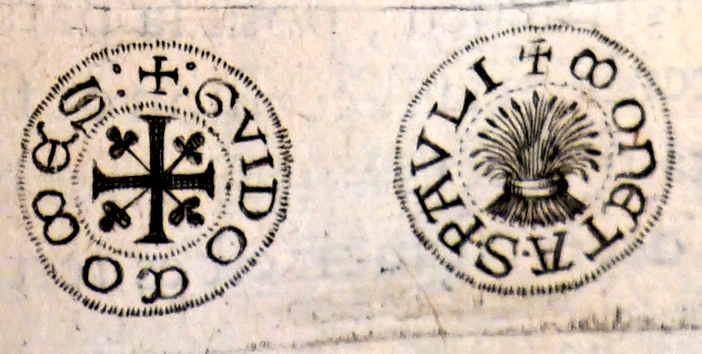
- Money of Count Guy of Saint Pol. The inscription reads [L] Gvido Comes (Count Guy), [R] Moneta S. Pavli (Money Saint Paul)
Montreuil (Montreiul-sur-Mer) was famous for its cloth industry from the 11th to 13th centuries. Its eight churches drew pilgrims from far and wide thanks to the relics of saints they held. The town's population exceeded 10,000, and in 1186, a royal castle (of which only two towers remain) was constructed after receiving a charter from Philip Auguste. Montreuil was severely damaged after enduring the Hundred Years' War from 1337 to 1453, and at some point during the war (around the turn of the 14th and 15th centuries), the Canche silted up and the port fell into disuse. [49]
Deforestation and human activity likely played a significant role in the silting, along with natural processes tied to the formation of the Strait of Dover, and longshore drift. [50]
Montreuil suffered further damage when Henry VIII of England and Charles V of Spain attacked. The town’s medieval walls held firm on this occasion. However, it was less fortunate in a siege in 1537, and eventually succumbed to the plague in 1596. [51]
Its modern replacement at the mouth of the Canche, Étaples (or Étaples-sur-Mer) had a population of around 10,000 - 12,000 in 2024. [52]
The House that held the County of Saint-Pol were the House of Azure, one garb Or in the 11th century and during the crusades. They became the later House Candavene (oat fields) of Azure, five garbs Or 1-3-1.
Their Cadet branch held Beauval, and may have (inferred by Robert) also held Comines as the House of Azure, three garbs Or, 2-1. We find Azure, three garbs Or as the coats of arms of both Beauval and (within a day's walk of Saint-Pol-sur-Ternoise) Capelle-Fermont. Also in the region, Azure three garbs Or is the arms of Bresle, Gerberoy, (and with a black twine) Béhagnies. [53] [54]
We also find Cumonville on the river Authie (which, in 1125-1150 is said to have been Chumont), and Bourg-et-Comin sits just south of Laon on the river Aisne; where 'Bourg' refers to a fortified settlement and "Comin" is believed to trace back to a personal name or family name, perhaps Gallo-Roman, and perhaps linked to Comines. Bourg-et-Comin has been settled since neolithic times. [55] [56] [57]
To the south of the region of the river Canche and on the river Somme lies the ancestral homeland of Clan Balliol, a close ally to Clan Comyn during the wars of Scottish independence. It is currently known as Ballieul commune, though it was once a castle; it is also known as Ballieul-en-Vimeu. However, its woth a note that a ballieul is also a type of fortification and not all places in France with a name containing 'Ballieul' are connected with the Balliol Family (most aren't, but specific ones are). [58]
These factors paint a scene of strong beginnings and support part of how Clan Comyn (of first Picardy-Flanders-Comines, then Northumbria, and then Scotland) rapidly gained power and lands through the Norman invasion, and subsequently went on to become one of Scotland's preeminent castle building clans. The Comyn's already had land, power, and connections.
The Picardy–Flanders borderlands around Saint-Pol and Comines were a particularly violent and contested frontier zone. This region had experienced almost continuous conflict for generations, with Viking raids of the 9th and 10th centuries giving way to persistent feudal clashes, castle-burning raids, and shifting alliances between the French crown and the powerful Counts of Flanders. This chronic instability, rooted in the long-term power vacuum following the breakup of the Carolingian Empire, placed families such as the Comyns in high demand as experienced border defenders and controllers both during and after the Norman invasion.[59] [60] [61] [62]
It is unlikely that the Comyns could afford the most lavishly equipped militia in William’s army, but their forces were likely more battle-hardened and pragmatic than many of the more expensive contingents drawn from wealthier but less frequently warring regions. This is not to suggest they were poor, merely that some participants came from immensely wealthy areas where military retinues sometimes served more for display than constant frontier duty. [63]
It is not improbable that Clan Comyn holds some ancient ties to the Morini, the Belgic people whose territory once encompassed the region around Thérouanne and Saint-Pol. While many (most) modern descendants also carry Viking ancestry, the Vikings never established permanent settlements or became a ruling class in the Pas-de-Calais area.
The region was too well defended, and according to tradition, the French crown offered land in the Flanders border zone to the Viking leader Rollo, but he did not want it.
Instead, he was given the territory that became Normandy in 911 after the Franks could not keep him off it. Vikings did, however, conduct significant raids along the Pas-de-Calais coast and frequently attacked the wealthy port of Quentovic. [64] [65] [66]
Northern France and adjacent Belgium preserve a mixed Belgic/Gaulish, Gallo-Roman, Germanic, and Romance place-names. Among them, Comines has been interpreted as deriving from the Gallo-Roman personal name Comminius, connected with the Gaulish King Commios, ally (for a time) of Julius Caesar. [67]
Of the town of Comines, while it is now divided between France and Belgium, this division is much more modern than its age. The historic town lay on both sides of the river Lys, with its northern and southern parts tied by lordship, parish, bridge, and local economy before modern state borders created separation. The Treaty of Utrecht in 1713 first made the Lys a state frontier there, placing the north in the Austrian Netherlands and the south in France.
While no direct blood link exists: if Robertus de Comines is named after this town of Comines; which in turn may be named after King Commios; who was granted restoration of laws, rights and tax-exempt leadership of the Atrebatians (immunity), and leadership over the Morini by Caesar; it may be that clan Comyn is a namesake extension of this Atrebatian history.
Very nearby and further up the river Lys towards Thérouanne lays the small fief of Commines, only 6km from Thérouanne and 35km from Saint-Pol-sur-Ternoise. There is little available information on it, but it seems it may have been a landed jurisdiction or named estate.
We can see in 1570 (17 years after the scorched-earth destruction of Thérouanne) that: "Alexandre Le Febvre, collector for the King's domain in Aire, acquires, by contract dated March 31, 1570, the fiefs of Villers, Commines, Guarbecques, [and] Mazinghem." ie. a wealthy royal official using his wealth to buy up property and expand his personal estate.
As the fief is changing hands and not being created, and as it is listed using the old Thérouanne jurisdictional framework (régale de Thérouanne), then the fief of Commines may predate the fall of Therouanne by a little or a lot. [6x]
Because Thérouanne’s documentary world was heavily disrupted by its destruction in 1553, the absence of earlier evidence does not eliminate the possibility that this Commines was older. It remains plausible but undenyingly difficult to prove this alternative to the now-better-known Comines on the Lys as a possible source of the de Comines/Comyn name.
Some have previously raised Bosc-Bénard-Commin as a potential origin of Clan Comyn. The earliest record of this place named so is 1224 as "Boscus Bernardi Commin" in the cartulaire de Bourg-Achard. 'Bos' and its variants mean 'wood' (like a forest), 'Bénard' is an anthroponym (it is named after a person/family), and 'Commin' is a nickname of the feudal lord, or controlling noble.
It is possible someone of Clan Comyn descent controlled this region around the time of 1224, but not possible as an origin if the Norman invasion was in 1066 - unless significant records are missing.
Our shield is a historical clue. What it is, where it appears, and what regional world may have produced it, may be researched; what may be ancestral, what may be collateral, and what may be coincidental of it, are also relevant here; and the information referenced may be tested and built on for and by future Cumings rigorously.
Clan Comyn is not the only house of Azure, three garbs Or, two and one. This is part of the purpose of this page. Kin and gens can be considered roughly synonymous to refer to the broader family group and extended lineage. Kin for the extended family or bloodline, gens for clan/group of families sharing a common ancestor.
Shields could evolve with coincidental convergence at that time. That is to say, independently of one another. It was not until around AD 1300 when we can say they became regulated. However, it was moderately rare and exact duplication was unusual before AD 1300.
House Blondeville, Azure, three garbs Or, 2-1 is thought to possibly trace back through their Gernon line to Querrieu (Picardy), about 70km from Saint-Pol.
House Blondeville are also known as the first Earls of Cheshire; though, the 6th Earl of Cheshire is the first to be surnamed Blondeville, Ranulf de Blondeville. They also use a lion that is both very similar to ours, and very similar to a cadet of Saint-Pol (Candavène-Plessis). Lions however, are not uncommon.
The Earldom (equivalent of French County) was one of the most powerful earldoms in medieval England, extending principally over the counties of Cheshire and Flintshire. Since 1301 the title has generally been granted to heirs apparent to the English throne (the British throne since 1707), and from the late 1300s it has been given only in conjunction with that of Prince of Wales. The current holder in 2024 is William, Prince of Wales.
Cheshire is a bordering southern neighbour of Northumbria.
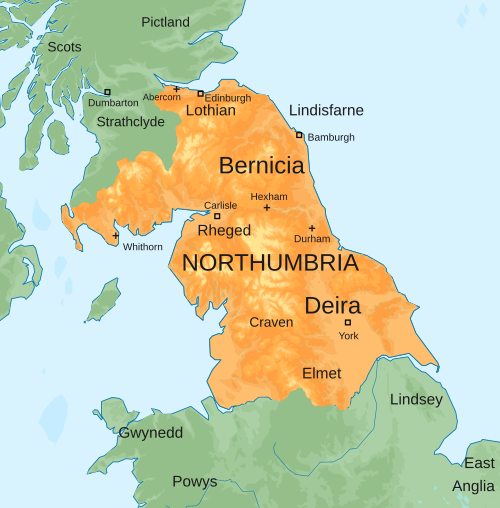
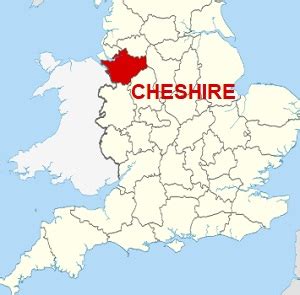
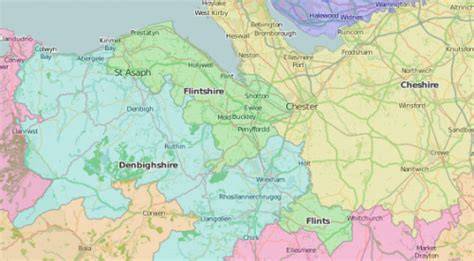
The independent palatinate jurisdiction of Chester survived until the time of King Henry VIII (1536), when the earldom was brought more directly under the control of the Crown. The palatinate courts of Great Sessions and Exchequer survived until the reforms of 1830.
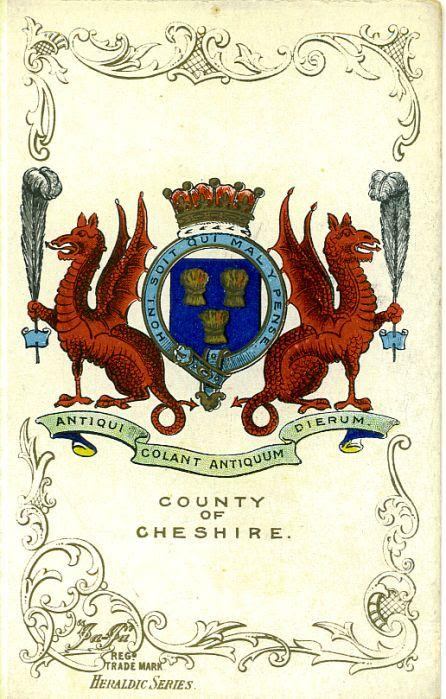
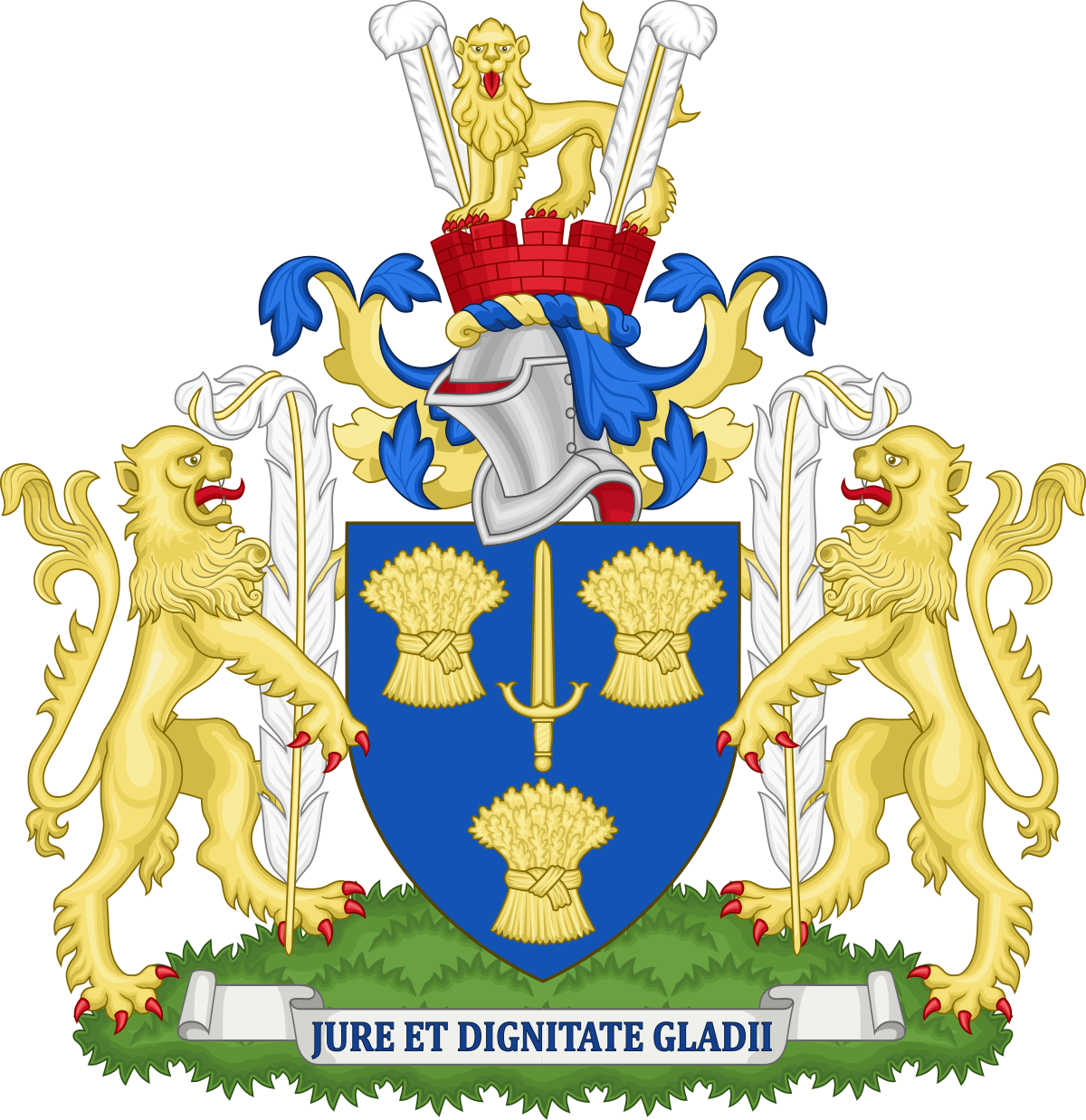
From the 1100s to c.1560 the Arms of Cheshire were three golden wheat sheaves on azure without sword, similar to, but not the same as the above with wyverns as supporters.
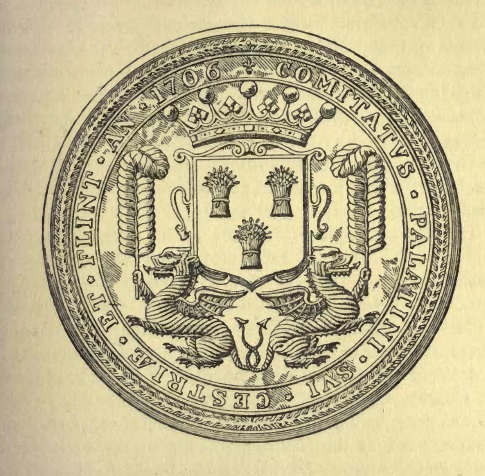 These arms with wyverns appear to be the same as the seal of the Chester Palatinate Court.
However, some time between supposedly 1560 and a 1581 map of the city by Georg Braun (below), the arms have changed to include a sword. This change is supposedly under the assertion that the Earl of Chester held the lands of the County Palatinate “as freely by his sword as the King of England held by his crown”.
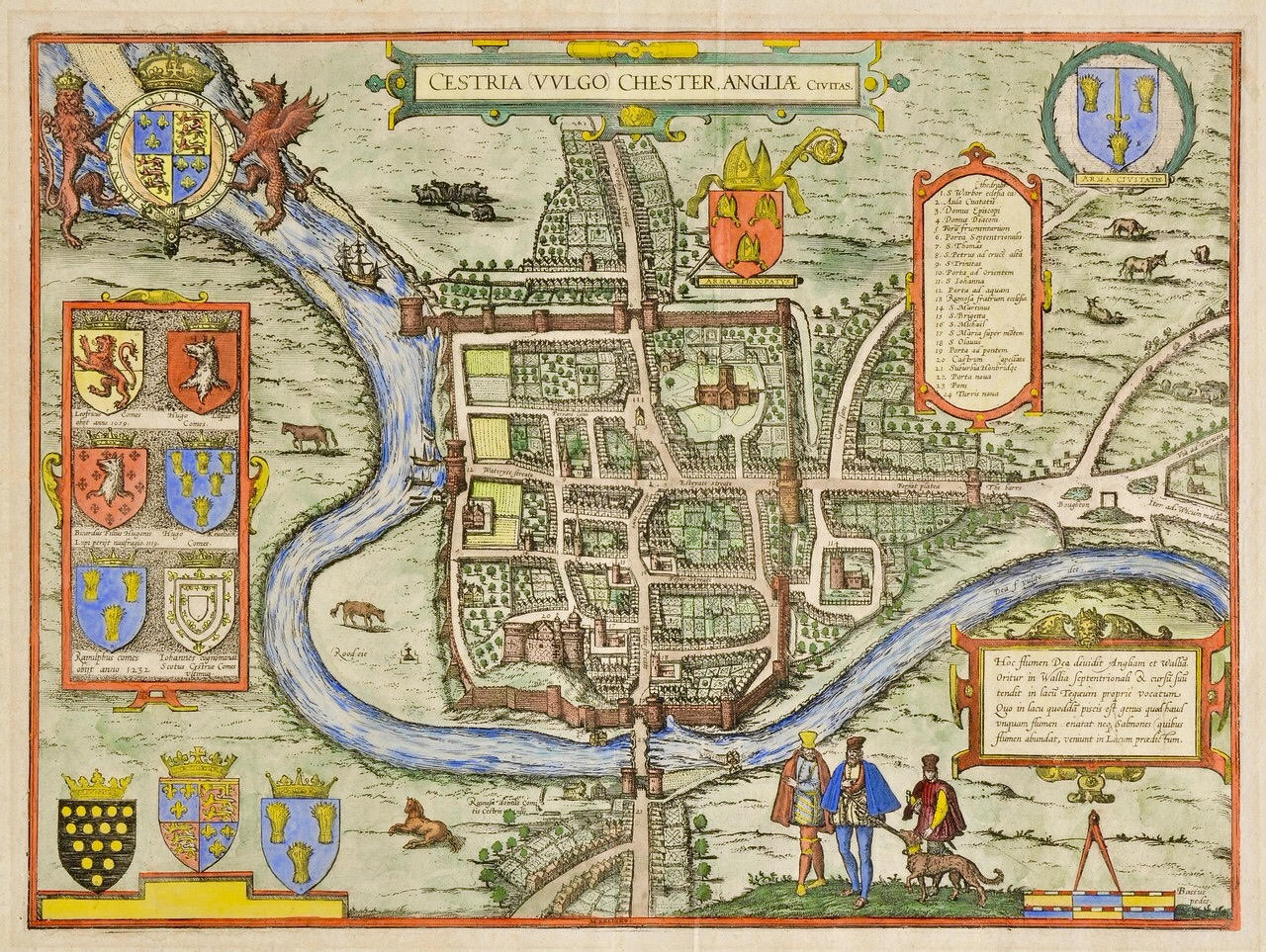
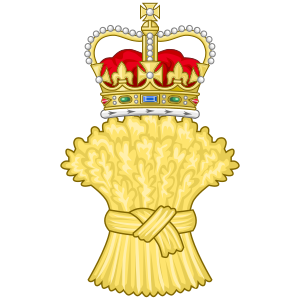 The emblem of Cheshire is Azure, three garbs Or, 2-1, as shown above in both the bottom left (without sword), and top right (with sword).
This is reflected (right) in the Chester Herald of Arms in Ordinary. An officer of arms in the College of Arms in London, it is part of the Gallo-British (French-British) Heraldic tradition.
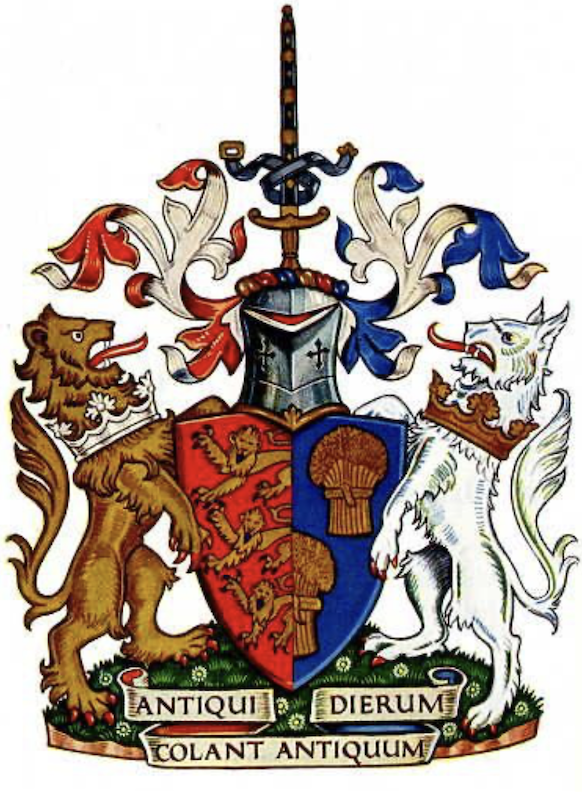
The Emblem of the City of Chester (left) is Azure, three garbs Or, 2-1, Supported by a lion on the left and wolf on the right. The Latin inscription reads 'Antiqui dierum colant antiquum', which can be translated to "Let the ancients of days cherish antiquity" or more easily understood as "Let the elders venerate the ancient".
References
1. "Azure, three Garbs Or": https://ia803105.us.archive.org/22/items/heraldryinscotla02stev/heraldryinscotla02stev.pdf - page 276
2. "Shield arrangement": https://wappenwiki.org/index.php/House_of_Comyn
3. "Royal Tressure": https://ia801305.us.archive.org/8/items/heraldryinscotla01stev/heraldryinscotla01stev.pdf - page vi (preface)
4. "Granting of the Royal Tressure": https://www.gutenberg.org/files/41617/41617-h/41617-h.htm or https://archive.org/details/completeguidetoh00foxdrich/page/144/mode/2up?q=tressure - bottom of page 144 - top of page 145
5. "Comyn shield with tressure, circa 1370-1414": https://www.heraldry-scotland.co.uk/gelre.html and https://uurl.kbr.be/1733715 - page 135, bottom left
6. "Comyn Flemish roots": https://www.altyre-estate.co.uk/about-altyre-estate/clan-cumming-timeline - (1030s)
7. "Therouanne / Tervanna, capital of the Morini": 2nd Century AD, "Geography" by Ptolemy https://penelope.uchicago.edu/Thayer/E/Gazetteer/Periods/Roman/_Texts/Ptolemy/2/8*.html - Book 2, Chapter 8
8. "Therouanne means 'land of oats' and has historic arms of Azure one Garb Or": 'Histoire de Thérouanne' by Etienne Pattou http://racineshistoire.free.fr/LGN/PDF/Therouanne.pdf - Title Page under "Armes anciennes de Thérouanne (présumées)"
9. "Celtic meaning of 'Tervanna'": 'Dictionnaire de la langue gauloise : une approche linguistique du vieux-celtique continental' by Xavier Delmarre https://archive.org/details/dictionnairedelal00dela
10. "Destruction of Therouanne": 'La destruction de Thérouanne et d’Hesdin par Charles Quint en 1553' by Pieter Martens https://www.academia.edu/12230898/La_destruction_de_Therouanne_et_d_Hesdin_par_Charles_Quint_en_1553_2007_
11. "The destruction of the city and cathedral of Thérouanne in 1553" by Oliver Blamangin https://journals.openedition.org/archeopages/536
12. "The Cathedral chapter of Thérouanne and its charters in the 12th century" by Benoît-Michele Tock https://archive.org/details/cartulairesdelg00fragoog/page/n18/mode/2up
13. "The Cartulars of the church of Thérouanne" by Th. Duchet & A. Giry of the Society of Antiquaries of Morinia, and originally created by the Catholic Church Diocese of Thérouanne https://archive.org/details/cartulairesdelg00fragoog/page/n10/mode/2up
14. "Clan Cumming Timeline" by Clan Cumming of Altyre Estate https://www.altyre-estate.co.uk/about-altyre-estate/clan-cumming-timeline
15. "Naming the transformation of English personal names" by James Chetwood https://etheses.whiterose.ac.uk/id/eprint/18307/1/James%20Chetwood%20-%20Thesis%20v3.0%20Final.pdf
16. "Origins of the Counts of St Pol" https://fmg.ac/Projects/MedLands/NORTHERN%20FRANCE.htm#_Toc127427758
17. "Noble Family Strategies in Late-Medieval Zeeland" by Arie van Steensel https://arievansteensel.wordpress.com/wp-content/uploads/2012/10/van-steensel-jfh-2012.pdf page 261
18. "Nobility and Titles in France" https://www.heraldica.org/topics/france/noblesse.htm
19. "A Survey of Roman Onomastic Practice from c. 700 B.C. to A.D. 700" by Benet Salway https://discovery.ucl.ac.uk/id/eprint/114213/1/SalwayJRS1994.pdf
20. "Names, Roman" by William Turpin https://works.swarthmore.edu/cgi/viewcontent.cgi?article=1049&context=fac-classics
21. "Roman Aristocrats in Barbarian Gaul" by Ralph Whitney Mathisen https://scourgeofgodblog.wordpress.com/wp-content/uploads/2016/12/roman_aristocrats_in_barbarian_gaul.pdf
22. "The Medieval Evolution of By-naming" by Iris Shagrir https://www.openu.ac.il/personal_sites/download/iris-shagrir/medieval-evolution-of-by-naming.pdf
23. "Patronymic bynames in medieval Western Europe" by Sara L. Uckelman https://dmnes.wordpress.com/2016/03/20/patronymic-bynames-in-medieval-western-europe/
24. "The knighthood in and around late medieval Brussels" by Mario Damen https://pure.uva.nl/ws/files/15604356/The_knighthood_in_and_around_late_medieval_Brussels.pdf
25. "House of St Pol, later known as House Candavène" https://wappenwiki.org/index.php/House_of_Candavène
26. "Dictionary of National Biography, 1885–1900, s.v. "Comin, Robert de,"" https://en.wikisource.org/wiki/Dictionary_of_National_Biography,_1885-1900/Comin,_Robert_de
27. "The Contribution of Flanders to the Conquest of England (1065-1086)" by R. H. George https://www.persee.fr/doc/rbph_0035-0818_1926_num_5_1_6418
28. "Robert de Comines, Earl of Northumbria" https://fmg.ac/Projects/MedLands/ENGLAND,%20AngloSaxon%20nobility.htm
29. "The Contribution of Flanders to the Conquest of England (1065-1086)" by R. H. George https://www.persee.fr/doc/rbph_0035-0818_1926_num_5_1_6418
30. "The Twelfth-Century Norman and Angevin Duke-Kings of England and the Northern French Nobility" by Heather J. Tanner https://www.cambridge.org/core/books/abs/anglonorman-studies-xliv/twelfthcentury-norman-and-angevin-dukekings-of-england-and-the-northern-french-nobility/813A406998ACC0A63A771B1B893F8E69
31. "Flanders" https://resources.saylor.org/wwwresources/archived/site/wp-content/uploads/2012/10/HIST302-4.2.3-Flanders-FINAL1.pdf
32. "Flanders" via The new Cambridge Medieval https://www.cambridge.org/core/books/abs/new-cambridge-medieval-history/flanders/BA10069D4C5DC5215B06E9B3FEBEDD32
33. "The impact of france upon the low countries from the middle ages until the 18th century" by David Klinck https://caans-acaen.ca/Journal/issues_online/Issue_I_ii_1980/Klinck1980.pdf
34. "The history of the department of Pas-de-Calais" https://www.pasdecalais.fr/histoire-du-departement-du-pas-de-calais-de-cesar-nos-jours
35. "Hunroch, Count of Ternois, 839 CE" https://fasg.org/projects/henryproject/data/hunro000.htm
36. "Location of the Morini" https://www.academia.edu/12732816/2012_Late_Iron_Age_Gold_Hoards_from_the_Low_Countries_and_the_Caesarian_Conquest_of_Northern_Gaul page 3
37. "Saint-Pol, a satellite of the Count of Flanders" https://research-repository.st-andrews.ac.uk/bitstream/10023/2641/3/AVMurrayPhDThesis.pdf pages 24, 102-103, 155, 176-177,
38. "History of the castle of the Counts of Saint-Pol" https://www.saintpolsurternoise.fr/articles/le-parc-du-chateau/
39. "The castle of Saint-Pol before its destruction by Charles V in the 1500s" https://www.persee.fr/doc/bulmo_0007-473x_1953_num_111_4_8150_t1_0405_0000_2
40. "Saint Pol, continuously beseiged by wars" https://www.saintpolsurternoise.fr/articles/histoire-de-la-ville/
41. "The origins of the Count of Saint-Pol" by P. Feuchère https://www.persee.fr/doc/rnord_0035-2624_1953_num_35_138_2072
42. "Ancient Boulogne: Gesoriacum and Bononia" https://www.ancientportsantiques.com/wp-content/uploads/Documents/PLACES/France/Boulogne-LeBourdelles1988.pdf
43. "The world of the early Capetian Court" by Talia Zajac https://www.academia.edu/112625558/_The_World_of_the_Early_Capetian_Court_987_1180_
44. "When Laon was the capital of France" https://www.hautsdefrance.fr/laon-capitale-france/
45. "Montrieul-sur-Mer" https://www.informationfrance.com/montreuil-sur-mer/
46. "Montrieul-sur-Mer, First royal port of the Capets" https://www.visitpasdecalais.com/countryside/rural-towns-and-villages-through-the-countryside/montreuil/
47. "Quentovic and Dorestad" by Simon Coupland https://www.researchgate.net/profile/Simon-Coupland/publication/227955724_Trading_places_Quentovic_and_Dorestad_reassessed/links/5d6cd9a6299bf1808d5eb65d/Trading-places-Quentovic-and-Dorestad-reassessed.pdf
48. "Port customs and Charlemagne's tax" https://arheo.ffzg.unizg.hr/ska/tekstovi/port_customs.pdf
49. "History of Montrieul" https://www.informationfrance.com/montreuil-sur-mer/
50. "Infilling of the Canche Estuary" by F. Francescangeli, M. Portela, E. Armynot du Chalet, G. Billion, T.J. Anderson, V.M.P. Bouchet, and A. Trentsaux https://www.academia.edu/115579059/Infilling_of_the_Canche_Estuary_eastern_English_Channel_France_Insight_from_benthic_foraminifera_and_historical_pictures
51. "History of Montrieul Citadel" https://www.spottinghistory.com/view/4345/montreuil-citadel/
52. "Population of Etaples" https://www.insee.fr/fr/statistiques/2011101?geo=COM-62318
53. The Oats of the Candavène. A return to the emblem of the counts of Saint-Pol and the birth of heraldry" by François Nieus https://www.academia.edu/25543188/Lavoine_des_Candavène_Retour_sur_lemblème_des_comtes_de_Saint_Pol_et_la_naissance_des_armoiries
54. Early Arms - as Attributed, Adopted, or Documented https://www.theheraldrysociety.com/wp-content/uploads/2019/10/CoA-232-Clemmensen-paper-2.pdf
55. "Bourg-et-Comin" https://www.genealogie-aisne.com/communes/02106/
56. "Bourg-et-Comin history" https://jpboureux.blog/2014/02/18/bourg-et-comin-ou-apprendre-a-regarder-pour-tenter-de-comprendre/
57. "Chumont to Cumonville" https://bouwstoffen.kantl.be/tw/lemma/?id=3492
58. "Origins of the Balliols" https://archives.balliol.ox.ac.uk/history/founders.asp#gsc.tab=0
59. "Family records of the Bruces and the Cumyns" https://deriv.nls.uk/dcn23/9507/95070997.23.pdf
60. "Clan Cumming" https://www.1066.co.nz/Mosaic%20DVD/whoswho/text/Clan_Cumming%5B1%5D.htm
61. "Flanders and Hainault" https://paulbuddehistory.com/europe/flanders/
62. "Medieval Principality of Flanders" https://www.britannica.com/place/Flanders-medieval-principality-and-historical-region-Europe
63. "The contribution of Flanders to the Conquest of England (1065 - 1086)" https://www.persee.fr/doc/rbph_0035-0818_1926_num_5_1_6418
64. "The historic city of Thérouanne" https://www.aud-stomer.fr/wp-content/uploads/2026/01/PAH_PARCOURS_02_Therouanne_VF_UK_19-01-2026.pdf
65. "Viking raids" https://uu.diva-portal.org/smash/get/diva2:1693951/FULLTEXT01.pdf Quentovic on page 7
66. "Vikings on Carolingian territory" https://www.britannica.com/topic/Viking-people/The-Carolingian-empire-and-France
67. "Naming of the town of Comines" by Raymond Schmittlein, in turn citing Dauzat and Rostaing: https://www.persee.fr/doc/rio_0048-8151_1973_num_25_3_2156
6x. "The fief of Commines aka Commimes" https://www.morinie.com/StatistiqueFeodale1.pdf page 164