THE COMYN FAMILY
Originally Flemish nobles, likely with some Viking heritage, the Comyn Family are frequently said to have carried their name from their region of Comines. The area was too well defended by the early Counts of Flanders for the Vikings to establish anything beyond temporary raids. Robertus de Comyn (brother-in-law of William the Conquereor, or otherwise related) came across to Britain as part of the Norman invasion in 1066. He fought for Count Baldwin V of Flanders, father-in-law of William the Conqueror.
Replacing the previous Anglo-Saxon Earl, Gospatric, he moved to Northumbria as its new Earl. He and his 700-or-so men made themselves so unpopular that Northumbrian rebel army killed him in 1069, despite forewarning by the local Bishop, Æthelwine. Fortunately for his descendants, he had produced an infant son or young heir before then. William the Conqueror was so displeased with this murder, he set to the swift and devastating response known as the 'Harrying of the North'.
The Comyns subsequently became one of the most important families in Scotland in the 13th Century. This began c 1210, with a marriage to the daughter of the last Celtic earl of Buchan, which provided the family with vast landholdings.
Their power grew through a web of marriage alliances with old and new noble families, combined with royal and church patronage.
The death of Alexander III of Scotland in 1286 (fell off his horse over a cliff), caused a dynastic crisis, which was ultimately the undoing of the Comyns, who had reached the height of their influence during his reign.
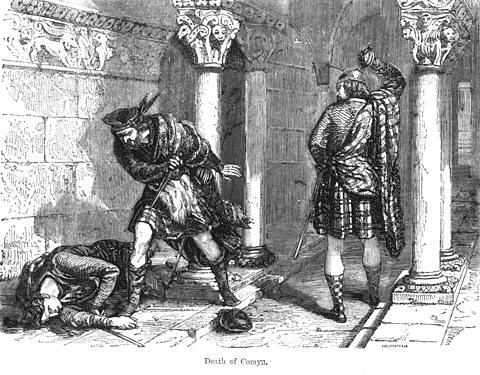 An interim ‘guardianship’ was appointed, to look after the affairs of Scotland while the succession was sorted out. John (The Red) Comyn was one of the guardians, as was Robert the Bruce. In a notorious event in Scottish History, Robert the Bruce stabbed John (The Red) Comyn in a church in Dumfries, after a violent quarrel between the two.
Both had been ‘competitors’ for the crown, which had required a submission to Edward I of England. Robert the Bruce didn’t immediately become King of Scotland, as John Bailliol was chosen (by Edward I).
John Bailliol was seen as ‘Edward’s man’, and didn’t gain much support from the Scottish Nobles. In an effort to been seen as decisive and independent, he started the Wars of Independence against England.
John was unsuccessful against a battle hardened English army, and suffered significant defeat and humiliation of Scotland. Robert the Bruce was subsequently more successful, with more of a guerilla warfare approach, and ultimately became King Robert I.
This marked the beginning of the end for the Comyns. They lived out the next few centuries in relative obscurity.
For those of you interested in a detailed account of the Comyns’ fight for the Crown of Scotland you should read Robert the Bruce’s Rival: the Comyns 1213-1314 by Alan Young (Tuckwell Press).